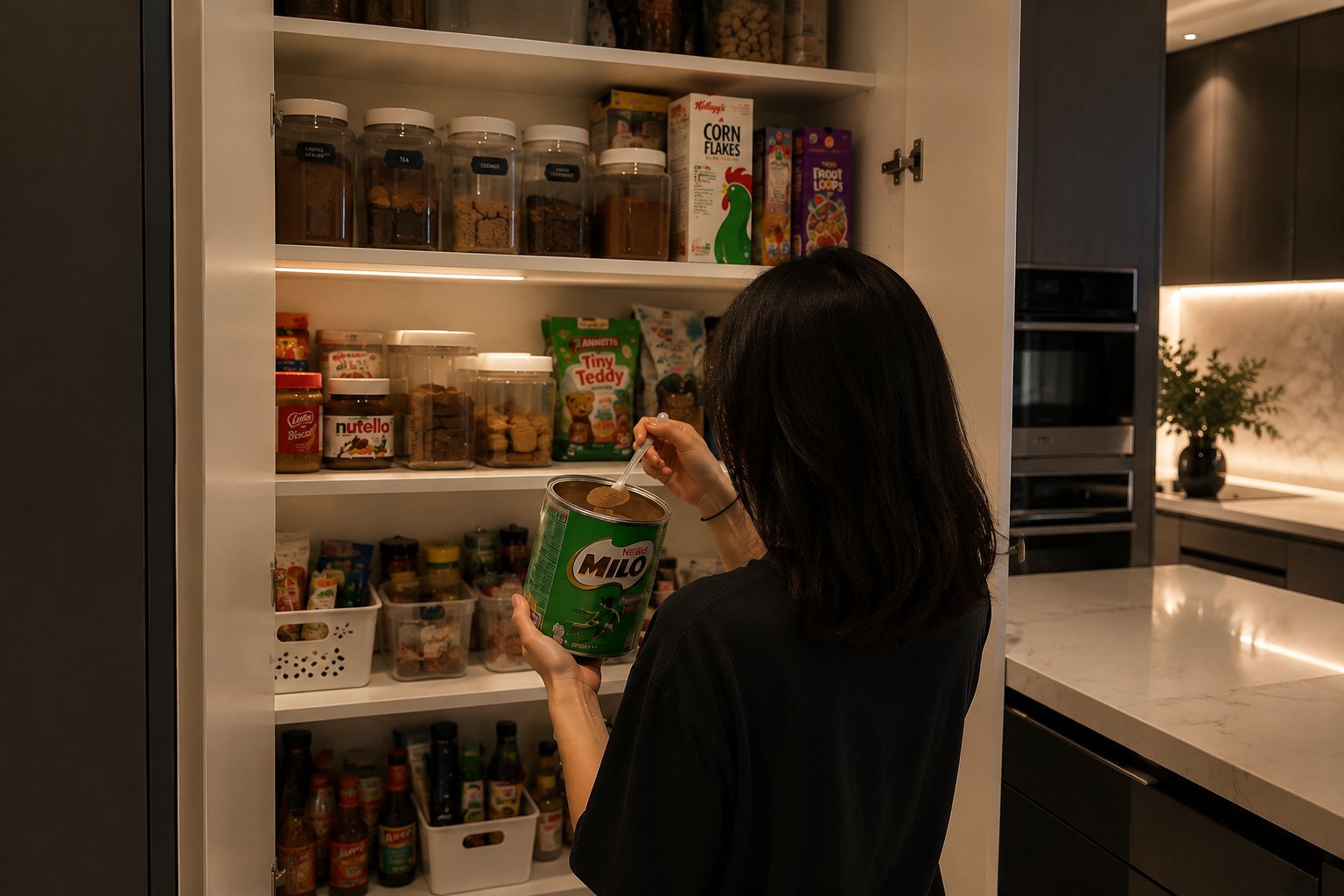
Six weeks out from a bodybuilding competition, I was standing in the pantry at midnight, eating Milo straight from the tin with a spoon.
This isn't a fitness story. It's the story of the moment you almost quit. The moment you were tired, sick of being disciplined, sick of being good, sick of doing the thing you said you were going to do. And suddenly whatever was sitting in the pantry, or on your phone, or in the bottle, or in the shopping cart, or in the message you knew you shouldn't send, started looking a whole lot more important than the goal you'd set when you were calm.
"Most people don't fail at the goal. They fail at the moment the tired version of them gets handed the microphone."
It's not the Milo. It's the moment before the Milo.
The Milo wasn't the problem. The spoon wasn't the problem. The pantry wasn't the problem. Even the caramel slice I started sneaking in alongside the Milo wasn't really the problem.
The real problem was the moment right before I opened the pantry door. That tiny moment where the tired version of me got handed the decision.
Your Milo might not be Milo. It might be scrolling. It might be wine. It might be online shopping. It might be cancelling the walk, ducking the conversation, skipping the session, or quietly closing the laptop on a course you paid good money for.
The thing itself isn't always terrible. The decision behind it is what matters. The question is: who's making the decision? The clear version of you, or the version that just wants relief?
Why people quit at 80%
Here's what most people get wrong about quitting. There's a difference between quitting because something is wrong for you, and quitting because something got hard. They are not the same thing.
Sometimes quitting is wisdom. Sometimes it's the cleanest, bravest decision you can make. The job was wrong. The relationship was wrong. The goal was never really yours.
But sometimes, what feels like a sign is just resistance with better branding. Sometimes hard isn't the wrong part. Sometimes it's the toll gate.
People get to 80%, 90%, almost there, and disappear. They self-sabotage. They get busy. They decide it isn't the right time. They change the goal. They start something new.
They don't fail because they were incapable. They fail because they mistook the hard part for a sign they should stop. At the beginning of any goal, you're changing your actions. At the end, you're confronting your identity. And if your old story is that you don't finish, then finishing will feel deeply uncomfortable, because the result challenges the version of you you've been rehearsing for years.
The property developer's Milo moment
If you're developing property in Australia right now, you have a Milo moment. You know exactly when it shows up.
It's month fourteen of a build that was meant to take ten. It's the third council knockback on the DA. It's the day the QS report lands higher than the feasibility allowed for. It's the offer that's twenty grand under what you need, and the agent quietly suggesting you just take it.
The tired version of you wants to bail. Drop the price. Walk away. Sell the site. Take the loss and move on.
Sometimes that's the right call. Most of the time, it isn't. Most of the time, you're standing six weeks out from your own version of the stage, exhausted, stressed, and emotionally negotiating with the part of yourself that always quits when projects get hard.
The developers who finish aren't the ones with no doubts. They're the ones who decided, before the project started, what they'd do when the hard part arrived.
Discipline is easier when the decision has already been made
This is the whole thing.
We make discipline complicated. We assume disciplined people wake up wanting to be disciplined. They don't. They wake up tired, cranky, busy, and full of the same human nonsense as everyone else. The difference is they're not making the decision from scratch every morning. They've already decided.
If you're deciding every morning whether to walk, you're making it too hard. If you're deciding every night whether to open the laptop, you're making it too hard. If you're deciding, every time you're stressed, whether to drink or spend or scroll, you're making it too hard. The decision is happening at the exact moment your least reliable self is in charge.
"A decision without structure is just a nice idea wearing active wear. Make the decision earlier. Build the structure around it."
How to find your Milo moment
Don't ask where you fail. Too vague. Ask where you start negotiating.
Is it at night, when you're tired? When someone criticises you? When progress slows? When no one's watching? After a mistake? Or, and this one stings, when things start getting visible and real?
Sometimes we think we're scared of failing. We're actually scared of finishing. Finishing changes things. Finishing removes the excuse. Finishing means owning the next level.
Once you know where you start negotiating, decide in advance what happens there. Something like: if I miss a day, I continue the next day. If I feel like quitting, I wait twenty four hours before deciding anything. If I break the plan at one meal, I don't turn it into a weekend. If I want to stop, I ask myself whether this is actually wrong, or whether it's just the part where I usually stop.
That last question changes a lot.
The shift
Your tired self doesn't get to run your empire. It can have a blanket. It can have a nap. It can have a little cry if it needs to. But it doesn't get the microphone.
"Monday isn't a strategy. Monday is where you send the decisions you don't want to make today."
The next time you have a messy moment, and you will, the line is: well, that happened, and now we continue. Not "I've ruined everything." Not "there's no point now." Not "I'll start again Monday."
You're not the person who almost finishes. You're the person who finishes.
Now decide like it.
P.S.
If you keep getting close to the finish line and pulling out, the full episode of The Milo Moment goes deeper into the bodybuilding story, the chilli powder in the Milo, and the question worth asking yourself before the next weak moment arrives. Listen on Spotify, Apple Podcasts, or wherever you get your podcasts.
Hilary x
Keep the conversation going.
Loved this? Hit reply to my newsletter, or come and find me over on Instagram at @hilarysaxton. I read every message.